
In today’s post, I’m going to dissect and fix a convoluted sentence from a summary-judgment brief. The sentence provides a useful example of how attorneys fatigue judges by being insufficiently considerate of their attention. First, a plug for this week’s online workshop:
Strong Sentences workshop
If you find this post helpful, I hope you’ll join me for my Strong Sentences workshop on Thursday, October 1. It’s limited to 20 participants, runs live on Zoom from noon to 1:30 p.m. Pacific (3–4:30 p.m. Eastern), and costs $145.
This workshop explores how to give your prose a sense of forward movement and use varied sentence structures to control pace and emphasis. You’ll also get a checklist to help you revise. Both active participants and passive listeners are welcome.
An unreadable sentence from an MSJ brief
The sentence in question is from the legal-standard section of a summary-judgment brief. It says:
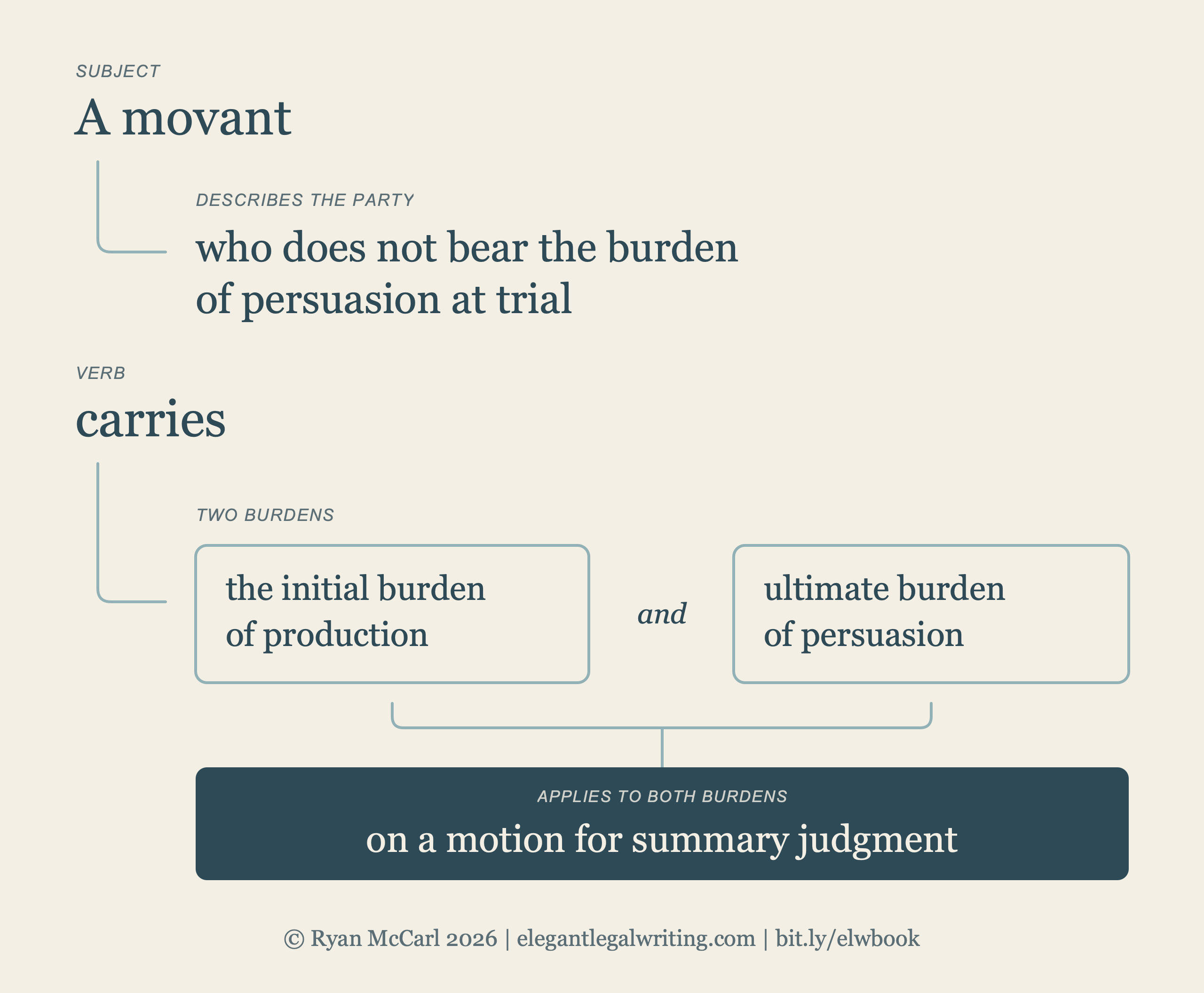
“A movant who does not bear the burden of persuasion at trial carries the initial burden of production and ultimate burden of persuasion on a motion for summary judgment.”
In practice, lawyers and judges are accustomed to prose like this and already have background knowledge about the summary judgment standard. They may see right through the sentence without being bewildered by its syntax. Even so, the syntax contributes to the overall burden placed on the reader, with no corresponding benefit.
I’ll share a few principles from Elegant Legal Writing that can improve it, then take a deeper look at why the sentence is so hard to follow.
1. Keep the main subject and verb close together.
The central failing of the example sentence is that it separates the main subject and verb (movant and carries) by ten words. We have to wade through a lengthy interruption — a relative clause describing the movant as one “who does not bear the burden of persuasion at trial”— before finding out what that movant does.
It is usually a good idea to keep the main subject and verb close together near the start of a sentence. Placing the main clause first and adding details afterward produces a right-branching sentence: think of the main subject and verb as the trunk of a tree, with further details in branches extending to the right. A left-branching sentence delays the main clause with introductory material.
The example sentence is a mid-branching sentence, one that adds details in the middle of the main clause. Proust, for one, wrote stunning mid-branching sentences.1 But they are rarely the best choice for attorneys.
2. Prefer shorter sentences.
All else equal, long sentences are harder to read because they require readers to hold information in mind longer and parse more material before a pause. Vary your sentences’ length, but prefer shorter ones, especially when you’re writing about something complex or abstract.
With long sentences, writers must be especially careful to use a transparent syntax — reinforced with punctuation like paired em-dashes or serial commas — while attending to rhythm, emphasis, and information-flow.
3. Write about characters performing actions.
There are several aspects of the “characters performing actions” advice, which is among the most helpful pieces of writing advice I have ever learned or taught.2
First, write about “characters” — human or personified actors — whenever you can. Movant is a clumsy procedural label meaning “the party that filed the motion.” The sentence could be improved by rebuilding it around a named party — e.g., “Jones, as the moving defendant, . . . .”
(Whether movant or moving defendant is better is a judgment call. Movant is familiar to litigators, but rare; it’s also close in sound and shape to movement.)
A broader principle underlying the “characters performing actions” advice is to write prose that a reader can visualize. Our example sentence, being a legal rule-statement, is inherently abstract. But beneath the surface, it contains visualizable metaphors. The notion of an argumentative obligation as a burden that one carries is metaphorical. Humans process abstractions through metaphorical links to bodily experience.3 Writers can use metaphors to help the reader process abstractions.
4. Prefer positive assertions.
Prefer positive assertions over negative ones. A negative requires the reader to understand a proposition (e.g., what it means to bear the burden of persuasion at trial) while keeping in mind that it is being negated. The reader must also determine how far the negation’s scope extends.
In our example sentence, the problem compounds because of the mid-sentence switch from a negative proposition (does not bear the burden of persuasion at trial) to a positive-form one (carries the burden). Indeed, the negative proposition is nested within the positive one, giving the reader too much to unpack.
5. Avoid ambiguity and needless variation.
Ambiguity. The phrase carry the burden is ambiguous in legal contexts because it can mean either bearing a burden or satisfying it. Words that can plausibly bear several meanings in context cause the reader momentary uncertainty and add to their cognitive burden. Using “has the burden” would sidestep this problem.
Needless variation. Writers shouldn’t swap in a synonym for something just referred to rather than repeating the referent. Our example sentence uses first bear, then carry, to describe the same act. This requires readers to recognize that the synonym refers to the same thing and that the text is continuing the discussion rather than introducing something new.
6. Trim rule statements to discard irrelevant information.
The phrase “a movant who does not bear the burden of persuasion at trial” is a precise but wearying way to describe a party who, in the standard summary-judgment configuration, is the defendant. Do we need the full description? Not unless the case we’re writing about diverges from the standard situation.4
Less common situations — those involving cross-claims or affirmative defenses — do not matter if, in this case, the defendant is moving for summary judgment based on the plaintiff’s inability to prove their claims. We can just write “the moving defendant” or “the defendant.”
Rule statements do not need to account for exceptional situations that have nothing to do with the current motion. Trim them to the situation at hand, leaving exhaustive explanations to treatises.
A broader tip is to consider readers’ default expectations when deciding how much to say. For most purposes, you only need to tell readers about information that diverges from defaults, not information that confirms them. (This is an application of philosopher Paul Grice’s second maxim of quantity: “Do not make your contribution more informative than is required.”)
7. Avoid sudden context shifts.
The example sentence forces the reader to track several distinctions at once: production versus persuasion, initial versus ultimate, and trial versus summary judgment.
The third distinction is especially taxing because it requires the reader to mentally leap between different procedural contexts. The brief’s procedural context involves summary judgment. The relative clause “who does not bear … at trial” switches the context to talk about trial. The main clause then returns to summary judgment: movant … carries … on a motion for summary judgment.
A better approach
What’s most unfortunate about the example sentence is that all its complexity serves no purpose. It wastes the judge’s cognitive resources on propositions that don’t matter.
Legal-standard sections should be kept as short as possible without sacrificing accuracy. They provide general, procedural rule statements at the outermost level of analysis. Since judges routinely handle summary-judgment motions, they can do without lengthy explanations of the procedural standard. The same is true for almost all motions and appeals.
An ideal legal-standard section provides a short summary of the procedural framework supported by footnotes to key cases where the framework is accurately stated and applied. Refer to specific aspects of the standard later on as they become relevant to the argument.
In a motion for summary judgment, I might skip the explanation of burden shifting entirely, instead using a footnote to point to a lengthier explanation in an authoritative source. If I felt I must discuss it, I’d walk the judge through its analytical steps rather than speaking of burdens in the abstract. Use the judge as the character performing actions.
Ryan McCarl is a partner of the business litigation firm Rushing McCarl LLP and author of Elegant Legal Writing (Univ. Cal. Press 2024). For more tips about legal writing and argumentation, subscribe to the Elegant Legal Writing blog, follow Ryan on LinkedIn, and sign up for an online writing workshop. McCarl’s book is available on Amazon and Audible.
Please share this post with your networks:
Subscribe for free to receive future Elegant Legal Writing posts by email:
Connect with Ryan McCarl: Order the Elegant Legal Writing book | LinkedIn | Rushing McCarl LLP | Linktree | Second Stage (blog) | Substack | Twitter (X) | Bluesky
This compound sentence from Within a Budding Grove has two independent clauses, each of which is mid-branching:
This kind of deceit which consists in having the boldness to proclaim the truth, but only after mixing with it an ample measure of lies which falsify it, is commoner than people think, and even among those who do not habitually practice it certain crises in life, especially those in which a love affair is involved, give them occasion to indulge in it.
2 Marcel Proust, In Search of Lost Time 103 (C. K. Scott Moncrieff & Terence Kilmartin trans., Everyman 2001).
The “characters performing actions” phrase comes from Joseph Williams’ Style: Lessons in Clarity and Grace (Pearson 2016). I discuss the concept in Elegant Legal Writing chapter 4 (“Strong Sentences”), § 4.4.
See, e.g., George Lakoff and Mark Johnson, Metaphors We Live By (Chicago 2023).
The plaintiff bears the burden of persuasion on their claims at trial. So, in that standard configuration, the movant who does not bear that burden is the defendant. Exceptions apply — defendants generally bear the burden of persuasion on their affirmative defenses and counterclaims — but needn’t be spelled out if they aren’t at issue.
Photo by Eilis Garvey on Unsplash
Amazon links contain affiliate tags. Thank you for supporting my work.