
The post below shares three ground rules for using AI in legal practice. First, though, if you want to learn advanced practical AI-assisted workflows for attorneys, sign up for my AI Workflows for Lawyers presentation:
AI Workflows for Lawyers (Presentation)
I can show you legal-AI workflows you haven’t seen before — ones requiring no software beyond a subscription to Claude or ChatGPT.
I use AI to run detailed cite-checks against authoritative sources, exposing weak support so it can be replaced or attacked; map evidence to pleadings and transcripts, checking for inconsistencies and gaps; and edit documents by talking about them. Join me for a live Zoom presentation and Q&A. You’ll leave with a handout of tips, custom instructions, and prompts.
October 15 · Noon–1 p.m. Pacific · Zoom · $149
I’m a practicing litigator who can code. I spent two years researching AI on the UCLA Law faculty, and I track AI developments every day.
I worry about how AI will affect education, art, and culture. Those reservations, however, do not stop me from using frontier AI models every day, usually in ways that don’t occur to other attorneys. AI can enhance productivity if you use it safely and effectively. That begins with staying committed to the everyday thinking and learning, reading and writing, and professional at-bats (depositions, mediations, oral arguments, trials, and the like) that slowly build deep expertise while giving clients the benefit of our best human thinking and professional judgment.
Earlier this year, I gave a talk at the University of Oklahoma College of Law about AI and legal writing, where I shared three ground rules for using AI in legal practice. AI can make you a better attorney if and only if you honor these:
Take extra precautions to ensure that your work is accurate. Attorneys are ethically responsible for what they say and write. This has always been true, including long before generative AI was invented. For example, attorneys cannot rubber-stamp filings prepared by inexperienced assistants, rely on a summer associate’s research memo without checking its reasoning and conclusions, quote something secondhand without checking and citing the original source, assume that cited cases remain good law, and so on.
Attorneys cannot delegate their ethical duties of competence and candor to an AI service any more than they could delegate them to a human assistant. Every significant legal and factual representation in a court filing must be checked, and the attorneys who sign legal briefs are always accountable for what they contain no matter how it got there.
Don’t assume that integrating AI into your workflows allows you to do less manual review before filing a brief. On the contrary, using AI requires more manual review. One AI-related blunder, such as a hallucinated citation, can destroy your reputation.Do your own thinking and writing. Use AI as an assistant, not as a substitute for your own thinking and writing. Most legal analysis is performed through the writing process. We learn and problem-solve by and through the act of writing. Sitting still with a blank page, and working to corral and organize one’s thoughts so they can be communicated effectively, is central to what great writers do, and the same is true for litigation attorneys.
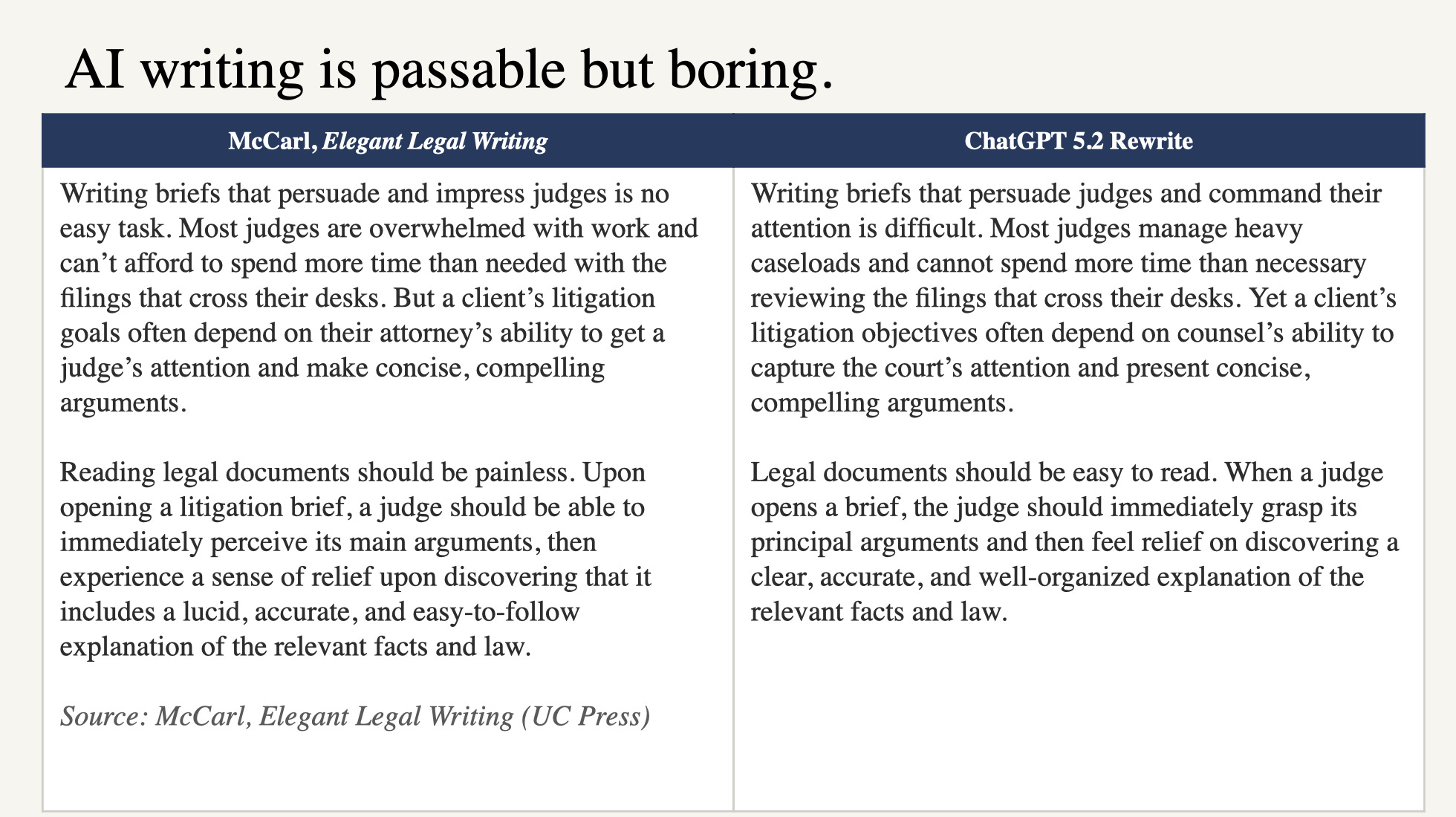
Using AI as a shortcut to do core reading and writing tasks can spare you labor, but the cost is too steep. Whatever creative ideas you would have arrived at through the traditional writing process will never occur to you, you won’t have the sense of ownership and understanding that comes with doing the work yourself, and your advocacy will suffer.Never try to pass off AI-generated text as authentic communication. AI prose is usually competent but shallow and mediocre, riddled with jargon and syntactic clichés. AI services can convey information in fluent, polished prose that is free of grammatical errors. But there is a difference between prose that is merely polished and prose that is compelling, that has a distinct style and voice capable of stirring and edifying those who read it, that can earn and deserve the attention of discerning human readers.
AI services’ imitations of human writing are often less impressive than they seem. The more knowledgeable a reader is on a topic, the more likely it is that they will find mistakes in AI-generated prose, and the less likely they are to find the text interesting or worthwhile.
Ryan McCarl is a founding partner of business litigation firm Rushing McCarl LLP and author of Elegant Legal Writing (Univ. Cal. Press 2024). For more writing tips, join one of Ryan’s writing workshops, subscribe to the Elegant Legal Writing blog, and follow Ryan on LinkedIn. McCarl’s book is available on Amazon and Audible.
Please share this post with your networks:
Subscribe for free to receive future Elegant Legal Writing posts by email:
Subscribe for free to receive new posts and support my work:
Connect with Ryan McCarl: Order the Elegant Legal Writing book | LinkedIn | ELW on Audible | Rushing McCarl LLP | Second Stage (blog) | Bluesky | Substack | Twitter (X) | Threads | Linktree
My Amazon links include affiliate codes. Thank you for supporting my work and helping improve our profession’s use of words.
Curious where you'd draw the line here. Client intake and status updates run on the same technology as the drafting work, just without anyone checking a citation.
Does the same caution apply, or does the risk profile change enough that it's a different conversation?